

Image
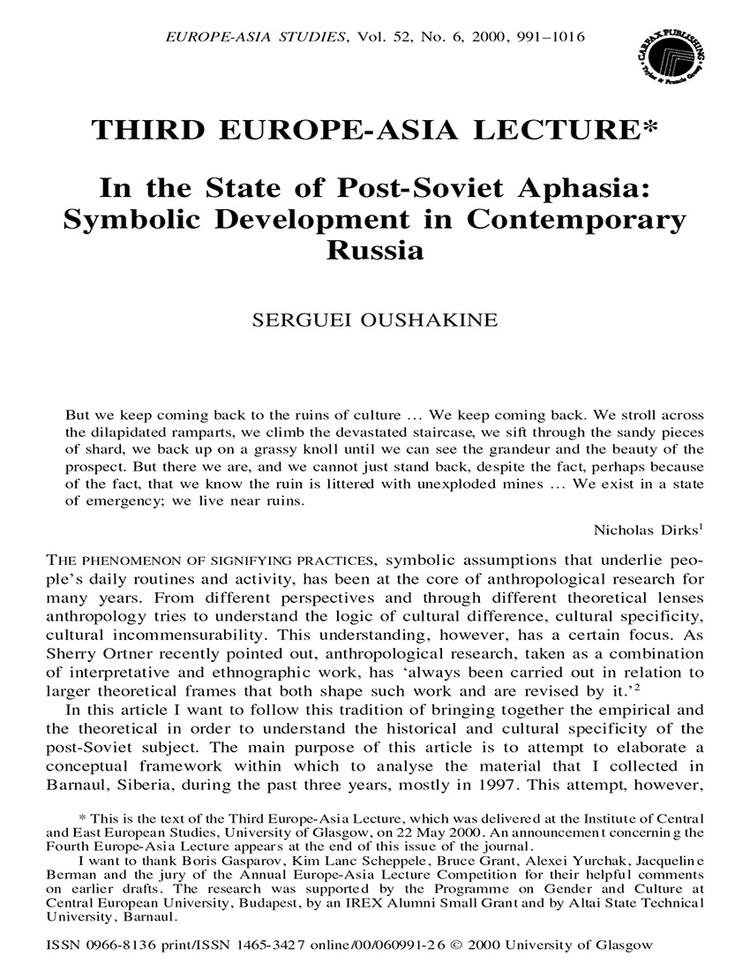
In the State of Post-Soviet Aphasia: Symbolic Development in Contemporary Russia
Publication Year
2000
Type
Journal Article
Abstract
As I have tried to show, the state of post-Soviet aphasia—with its nostalgic regression and over-used Soviet symbols—can be seen as a reaction to socio-cultural transformations that started happening in Russia in the second half of the 1990s. I have suggested that one of the most striking aspects of this discursive behaviour, demonstrated in the essays written by young Russians, was the loss of a metalanguage and thus the loss of ability to ‘dissect’ the metaphor of the ‘post-Soviet’. This lack of knowledge about one’s own location and being, I proposed, is closely connected with absence of the post-Soviet field of cultural production that could have provided the post-Soviet subject with adequate post-Soviet discursive possibilities/signifiers. Such absence of an adequate post-Soviet interpellation capable of ‘naming’ the subject undermines the very foundation of the existing discursive field and its institutions.The ‘post-Soviet’ remains an empty space, a non-existence, devoid of its subjectifying force, its own signifier, and its own meaning effect.
Journal
Europe-Asia Studies
Volume
52
Issue
6
Pages
991-1016