

Image
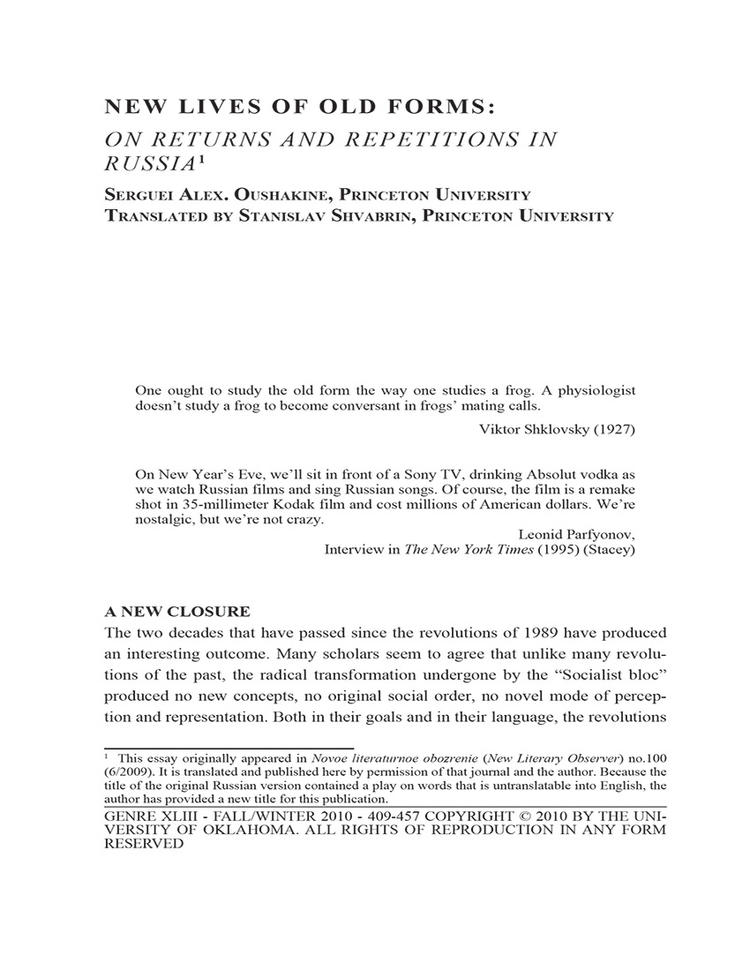
New Lives of Old Forms: On Returns and Repetitions in Russia
Publication Year
2010
Type
Journal Article
Abstract
I argue that the general epistemological conservatism, typical for the post-socialist “transition,” taken together with the imagined or experienced feeling of radically limited spatial choices, gave rise to a series of interesting symbolic shifts. An urgent search for a “new beginning,” a perceived state of semantic “indeterminacy” and “cognitive vacuum,” a recognition of the loss of all meaningful bearings was often represented as a disintegration of speech, as a deficiency of symbolic forms that could no longer express essential qualities of the current condition. The absence of comprehensive cognitive “maps” capable of representing the trajectory of development led to a pronounced preoccupation with the domain of minutiae, with tangible yet fragmented context. Also, this “being at a dead end” precipitated a move from the symbolism of space to the symbolism of time: “geography” gave place to “history.”
Journal
Genre XLIII
Pages
409-457